Community find
Ink cap mushroom (general)
Coprinellus or Parasola species
- Group
- gilled mushroom
- Season
- They can be found from spring through autumn, often appearing rapidly after rain, particularly in warmer, humid conditions.
- Habitat
- These mushrooms are commonly found growing in scattered to gregarious clusters directly from the ground, often in enriched soils, lawns, gardens, disturbed areas, wood chips, and sometimes directly from decaying wood or buried wood debris. They prefer moist conditions.
- Key characteristics
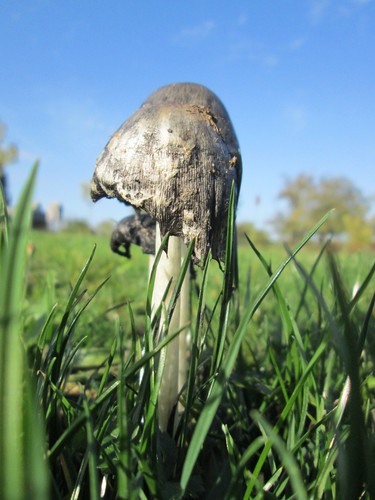
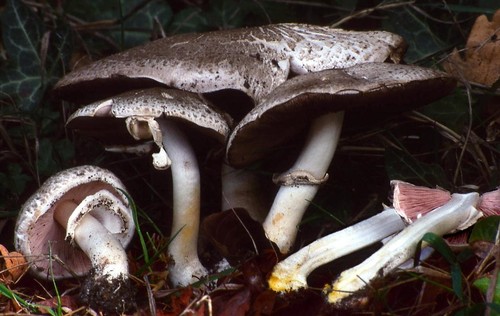
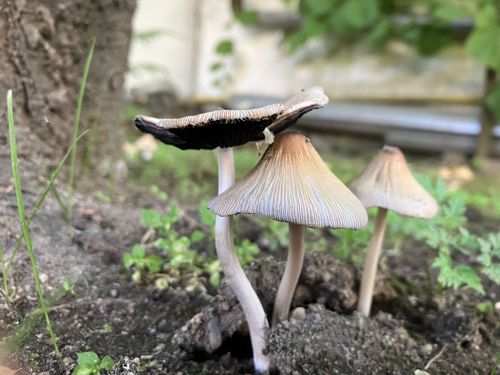
- These mushrooms, likely a species of Coprinellus or Parasola (genus of ink cap mushrooms), exhibit characteristic features. The caps are conical to bell-shaped, often streaked or pleated, and may be grayish-brown to light brown, fading with age. They are typically fragile and thin. The gills are prominent, free or adnexed, and change color with age, often turning dark brown to black as spores mature, and may deliquesce (dissolve). The stems are slender, white, and often hollow, without a prominent ring. Size can vary, but these appear to be relatively small to medium-sized.
- Look-alikes
- Many species within Coprinellus and related genera like Parasola, Coprinopsis, and Coprinus can look similar. Distinguishing features often involve microscopic examination of spores, presence or absence of veil remnants, cap texture (e.g., striations, pleats), and deliquescence patterns. For example, some 'true' ink caps (Coprinus comatus) have shaggy caps and are larger, while many Coprinellus species are smaller and more delicate.
- Ecological role
- Coprinellus species are primarily saprophytic, playing a crucial role in nutrient cycling by breaking down dead organic matter, particularly wood debris and other plant material in soil. They help return essential nutrients to the ecosystem, contributing to soil health and fertility.