Community find
Oak Maze Gill
Trametes betulina
- Group
- Polypore
- Season
- It is typically found from late spring through late autumn, and can persist through winter in some regions. It fruits annually in overlapping shelves.
- Habitat
- This fungus is saprobic, growing on dead hardwood, especially oak (Quercus), but also on birch (Betula) and other deciduous trees. It causes a white rot. It can be found on logs, stumps, and fallen branches.
- Key characteristics
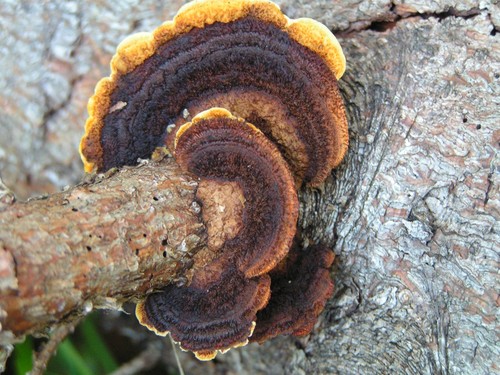
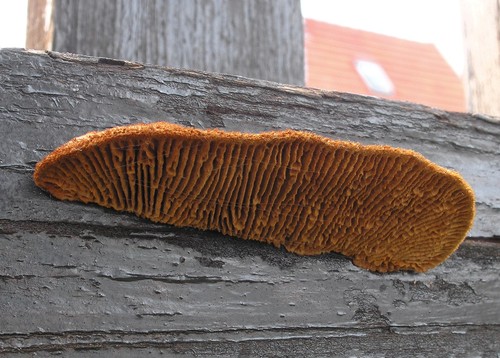
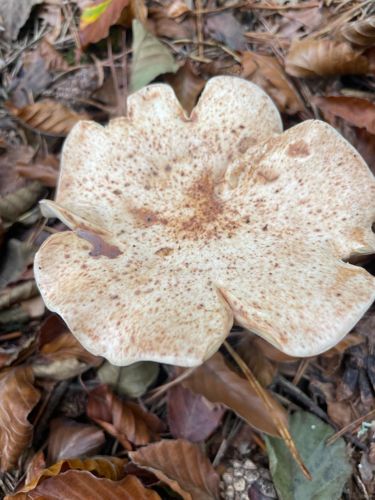
- Caps are semicircular to kidney-shaped, typically 3-10 cm across, flattened or slightly convex. The upper surface is whitish to buff, often with zones of tan, brown, or gray, and can be hairy to concentrically ridged. The underside has a distinctive maze-like or labyrinthine pore surface (lamellae-like pores) ranging from white to yellowish or reddish-brown. The flesh is tough and leathery. It lacks a true stem, attaching directly to the host. The spore print is white.
- Look-alikes
- Similar looking species include Stereum ostrea (False Turkey Tail) which has a smooth, non-poroid underside, and other bracket fungi. Unlike Trametes betulina, many bracket fungi have a distinct pore surface rather than the labyrinthine or lamella-like structure.
- Ecological role
- Trametes betulina is a saprobic fungus, meaning it obtains nutrients from dead organic matter. It plays a crucial role in forest ecosystems by breaking down dead hardwood, especially lignin and cellulose, contributing to nutrient cycling and the decomposition of wood. This process helps return nutrients to the soil for use by other organisms and clears dead wood from the forest floor.