Community find
Parasol Mushroom
Macrolepiota procera
- Group
- Gilled mushroom
- Season
- It is typically found from late summer through autumn, after periods of rain.
- Habitat
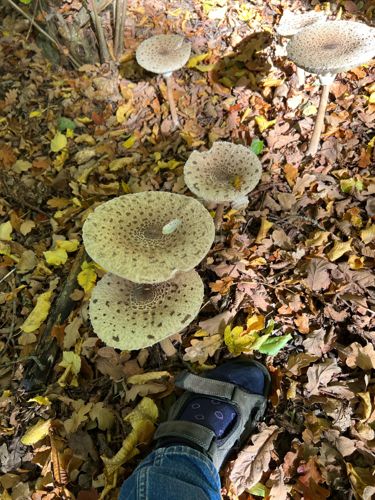
- This mushroom typically grows solitarily, scattered, or in groups on the ground in pastures, meadows, grassy areas in woodland, and at the edges of woods. It often appears in disturbed ground.
- Key characteristics
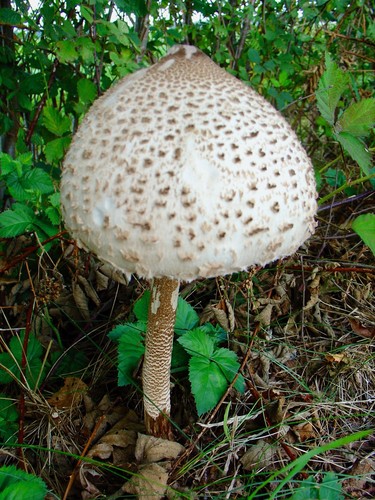
- The cap of the Parasol Mushroom is large, usually 10-30 cm across, initially egg-shaped or globose, expanding to broadly convex or flat. It has a distinctive umbo (central raised bump). The color is off-white to creamy or pale brownish, covered with large, shaggy, brown scales that are often darker towards the center. The gills are crowded, free from the stem, white to cream-colored. The stem is tall (15-40 cm) and slender, hollow, with a bulbous base, and features a conspicuous, movable double ring. It has a snakeskin-like pattern (zonate or mottled) on a brownish background. The spore print is white. The flesh is white and firm.
- Look-alikes
- Similar looking species include other members of the Macrolepiota genus, such as Macrolepiota rhacodes (Shaggy Parasol) which stains reddish or brownish when bruised and has larger, shaggier scales. It could also be confused with species of Chlorophyllum, especially Chlorophyllum molybdites (Green-spored Parasol), which has a green spore print and lacks the prominent snakeskin pattern on the stem. Always observe the spore print and stem characteristics carefully.
- Ecological role
- The Parasol Mushroom is a saprobic fungus, meaning it obtains nutrients by breaking down dead organic matter. It plays an important role in decomposition, recycling nutrients back into the ecosystem, especially in woodland and grassland environments by breaking down leaf litter and other plant debris.