Community find
King Bolete
Boletus edulis
- Group
- Bolete
- Season
- The King Bolete is typically found from late summer to late autumn, depending on the region and local climate conditions. Its fruiting is often triggered by periods of rain followed by warmer temperatures.
- Habitat
- The King Bolete is typically found growing on the ground in coniferous and mixed forests, often in association with spruce, pine, fir, and sometimes hardwood trees like oak and birch. It prefers well-drained soil and can be found in mossy areas or among leaf litter.
- Key characteristics
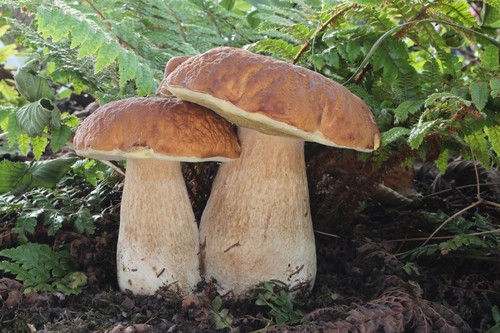
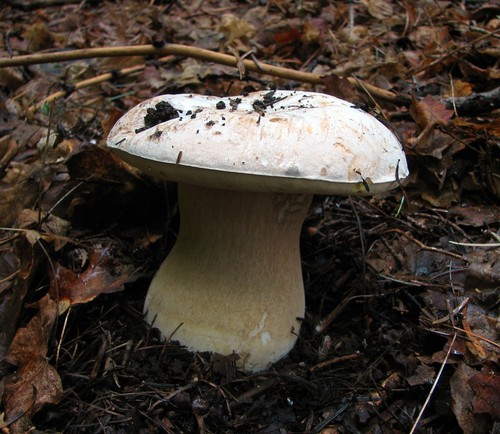
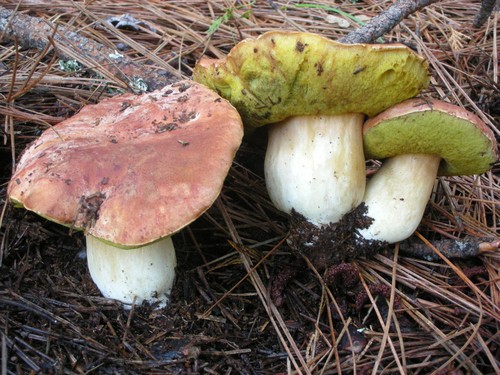
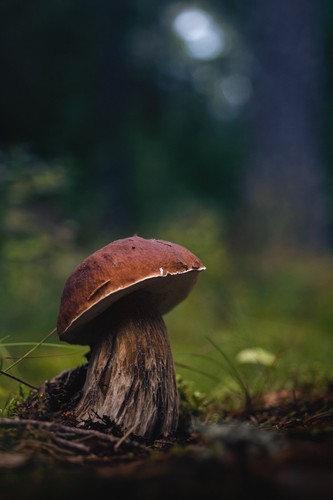
- The King Bolete (Boletus edulis) has a cap that ranges from light brown to reddish-brown, often convex to broadly convex, and can be greasy to slightly tacky when moist, becoming dry. The size of the cap typically ranges from 7 to 30 cm (2.8 to 11.8 inches) in diameter. The pore surface underneath the cap is initially whitish to grayish, turning yellowish-green with age, and does not stain blue when bruised. The pores are very fine. The stem is club-shaped or bulbous at the base, thickening upwards, and is typically whitish to brownish with a distinctive fine white to brownish net-like pattern (reticulation) near the top. The flesh is firm and white, non-staining when cut (though some varieties may show very slight discoloration). The spore print is olive-brown.
- Look-alikes
- Other species that can look similar include Tylopilus felleus (Bitter Bolete), which has pinkish pores that stain reddish-brown and very bitter flesh; Boletus reticulatus (Summer King Bolete), which has a velvety cap and grows earlier in the season; and other members of the Boletus group. Distinguishing features include the pore color, reticulation on the stem, and the absence of blue staining when bruised (for B. edulis). Careful examination of the pore surface color, stem reticulation, and lack of strong bruising reaction on the flesh helps differentiate it from look-alikes.
- Ecological role
- The King Bolete is a mycorrhizal fungus, meaning it forms a symbiotic relationship with the roots of certain trees. It exchanges nutrients and water with the trees, receiving carbohydrates in return. This mutualistic relationship is vital for the health and growth of the host trees, making it an important component of forest ecosystems. It helps with nutrient cycling and water uptake for its tree partners.