Community find
Rooting Shank
Hymenopellis radicata
- Group
- gilled mushroom
- Season
- It is typically found from late spring through fall.
- Habitat
- This mushroom is saprobic, growing singly or scattered on decaying hardwood, often appearing at the base of dead or living deciduous trees, or on buried wood. It prefers moist woodland environments.
- Key characteristics
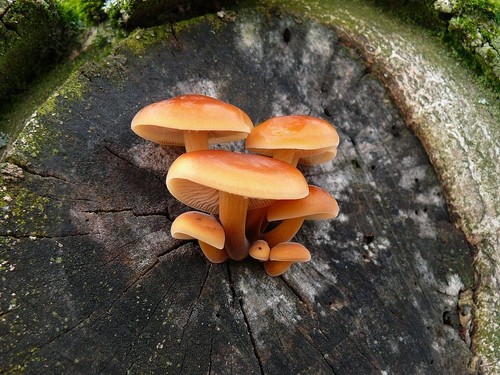
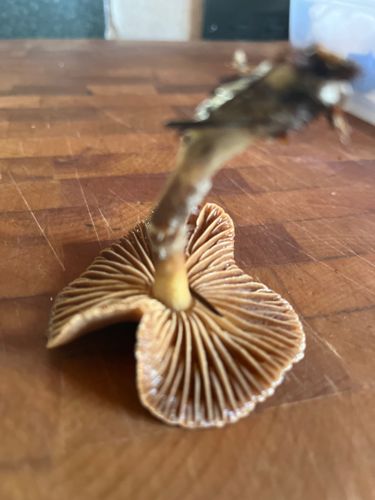
- The cap of Hymenopellis radicata (formerly Xerula radicata) can range from light tan to dark brown, often wrinkled, and sticky when moist. It is typically convex to broadly convex, flattening with age, and can be 5-15 cm in diameter. The gills are broadly attached to almost free, white to cream-colored, and widely spaced. The stem is distinctively long and tapers towards the base, often deeply rooted into the substrate, hence the name 'radicata'. It is usually tough and fibrous, whitish near the cap and darker brown towards the base, and can be 8-20 cm long and 0.5-2 cm thick. The spore print is white.
- Look-alikes
- Other species in the genus Hymenopellis. For example, Hymenopellis furfuracea (formerly Oudemansiella furfuracea) has a velvety, non-sticky cap and a less deeply rooting stem. Hymenopellis megalospora is another similar species but differs in microscopic features and typically has a deeply grooved stem.
- Ecological role
- Hymenopellis radicata is a saprobic fungus, meaning it obtains nutrients by decomposing dead organic matter. It plays an important role in the forest ecosystem by breaking down fallen wood and returning nutrients to the soil. This contributes to the overall health and nutrient cycling of woodland environments.