Community find
Rough-stemmed Bolete
Leccinum scabrum
- Group
- bolete
- Season
- Summer to early autumn, typically from July to October, depending on geographical location and weather conditions. Requires adequate moisture.
- Habitat
- Found on the ground, often in association with birch trees in woodlands and forests, but can also be found with other deciduous trees like aspen or oak. Prefers disturbed areas and well-drained soil.
- Key characteristics
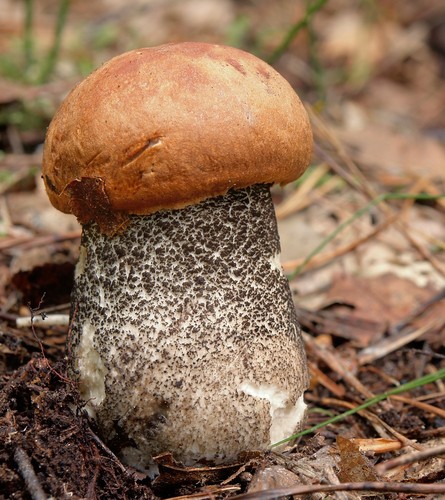
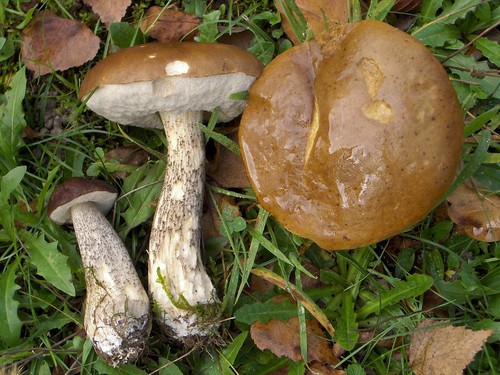
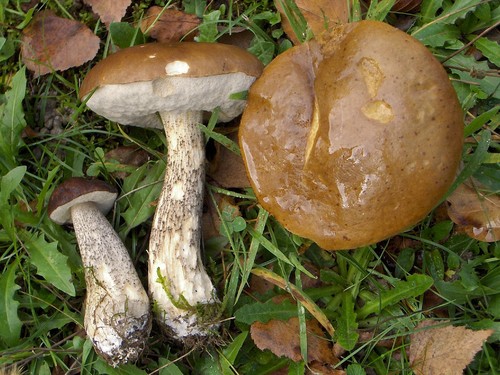
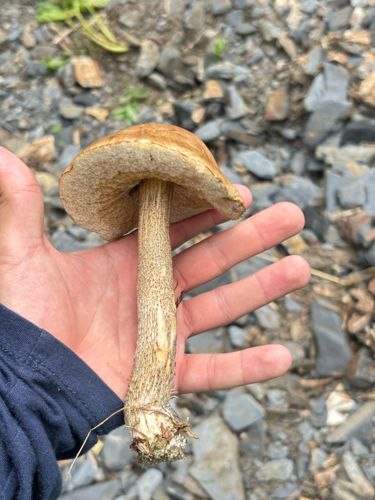
- Cap is typically convex to broadly convex, tan to orange-brown, often tacky when moist. Underside has pores, not gills, which are whitish to grayish, bruising brownish. Stipe (stem) is robust, somewhat tapered towards the top, off-white to brownish, covered with dark scabers (small, rough projections) especially visible on a young specimen. The flesh is white and may bruise slightly pinkish or grayish when cut.
- Look-alikes
- Other species within the genus Leccinum are often quite similar and differentiating them can be challenging. For example, Leccinum holopus (White Birch Bolete) has a paler cap and stem. Leccinum versipelle (Orange-capped Bolete) has an orange cap and the flesh typically stains bluish when cut. Identification often requires careful examination of cap color, pore color changes, and the presence/color of scabers on the stipe, and the type of tree it grows under.
- Ecological role
- Mycorrhizal, forming a symbiotic relationship with trees, particularly birch. The fungus helps the trees absorb water and nutrients, and in return, the trees provide the fungus with carbohydrates produced through photosynthesis. It plays a vital role in nutrient cycling in its associated forest ecosystems.