Community find
Saffron Milkcap
Lactarius deliciosus
- Group
- gilled mushroom
- Season
- Late summer to late autumn, depending on the region and rainfall.
- Habitat
- Lactarius deliciosus is typically found growing on the ground, often among moss or leaf litter, in coniferous forests, particularly under pine trees. It prefers well-drained, sandy soils.
- Key characteristics
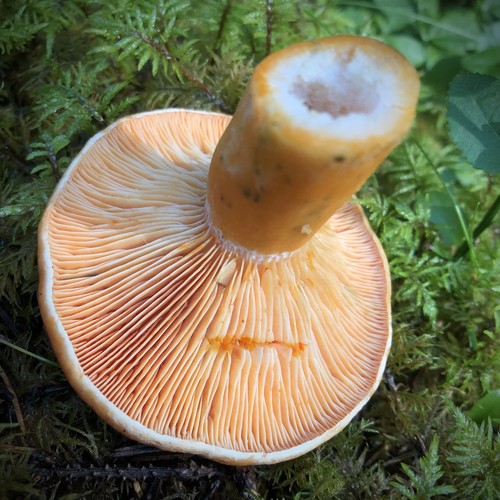
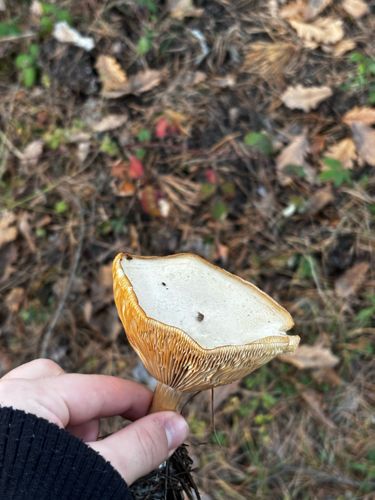
- The image shows a mushroom with decurrent gills, meaning they run down the stem. The gills appear to be closely spaced and are lighter in color than the cap surface, possibly cream or light tan. The cap itself is broadly convex to flat, with an irregular margin and a pale underside. The upper surface of the cap is not clearly visible but appears to be a different color than the gills. The stem is relatively thick and could be the same color as the gills or a slightly darker shade.
- Look-alikes
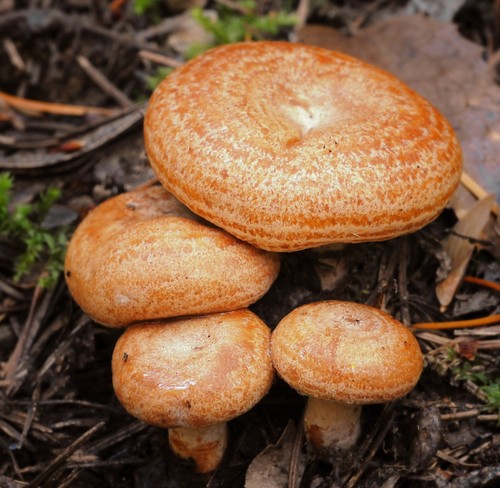
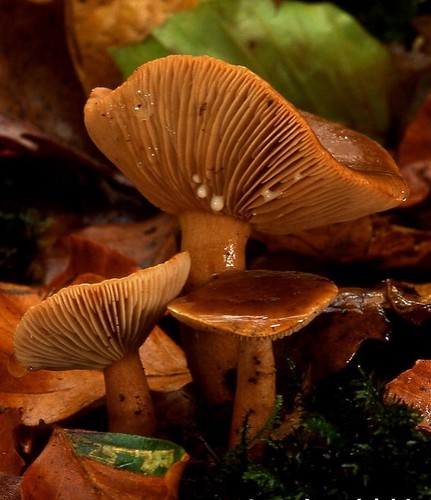
- Lactarius deliciosus can be confused with other orange or reddish-orange Lactarius species, such as Lactarius salmonicolor (often found under firs, less greening), Lactarius deterrimus (primarily associated with spruce, stains green more readily and intensely), and Lactarius sanguifluus (exudes a wine-red latex, not orange). Key distinguishing features include the color of the latex (orange in L. deliciosus, turning greenish), the tree association, and how the mushroom bruises or stains (L. deliciosus often stains green with age or handling). The distinct concentric zones on the cap are also a helpful identifier, though not clearly visible in this image.
- Ecological role
- Lactarius mushrooms are typically mycorrhizal, forming symbiotic relationships with the roots of various trees. They help their host trees absorb water and nutrients, particularly phosphorus and nitrogen, in exchange for sugars produced by the tree through photosynthesis. They play a crucial role in nutrient cycling in forest ecosystems.