Community find
Velvet-footed Pax
Tapinella atrotomentosa
- Group
- Gilled mushroom
- Season
- Typically found from late summer through autumn, though it can appear in other seasons given suitable moisture and temperature conditions.
- Habitat
- This mushroom is saprobic, growing on dead coniferous wood, stumps, and logs, often buried in duff. It can be found singly or in small groups, particularly in coniferous and mixed forests.
- Key characteristics
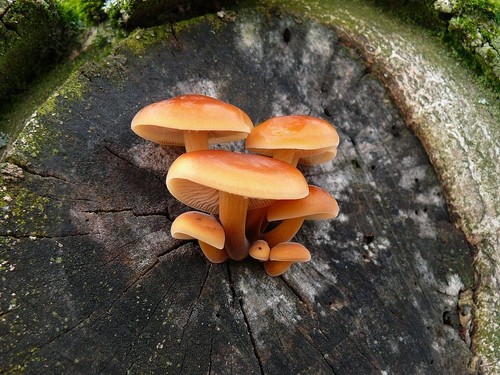
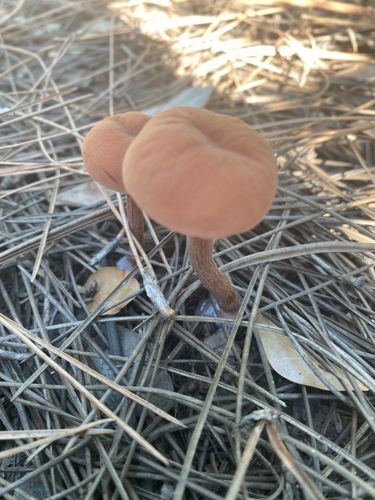
- The cap of Tapinella atrotomentosa is typically 5-20 cm in diameter, convex to flat or somewhat depressed, often kidney-shaped, or irregular. It is ochre-brown to dark brown, with a velvety or finely hairy surface. The margin is often inrolled when young. The gills are yellowish to brownish, decurrent, forked often, and easily separable from the cap. The stem is stout, central or eccentric, 3-8 cm long and 1-3 cm thick, covered with fine, dark brown to black velvety hairs, which gives it its common name. The flesh is yellowish to brownish and rather firm. The spore print is yellowish-brown to olive-brown.
- Look-alikes
- Other species in the genus Tapinella might look superficially similar, but 'Tapinella atrotomentosa' is distinct due to its large size, characteristic velvety dark brown stem, and occurrence on conifer wood. Some Cortinarius species may have similar colors but differ in gill attachment, spore print, and the presence of a cobwebby cortina. Paxillus involutus has a different stem and often grows with deciduous trees.
- Ecological role
- Tapinella atrotomentosa is a saprobic fungus, meaning it obtains nutrients by decomposing dead organic matter, primarily coniferous wood. In doing so, it plays a crucial role in nutrient cycling in forest ecosystems, breaking down complex wood compounds and returning essential nutrients to the soil. This process of decomposition is vital for forest health and regeneration.