Identification guide
Fly Agaric Identification Guide
A complete field read of Amanita muscaria, from the warted scarlet cap and free white gills down to the girdled, shaggy-ringed basal bulb that anchors the identification.
The Setting and the First Impression
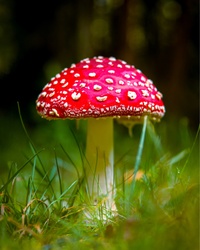
The classic encounter is under birch on light, acidic, sandy soil, or in a pine or spruce plantation on heathy ground, from late summer through autumn. Parks, plantation edges, heaths, dune slacks with creeping willow and roadside birch belts all produce it reliably, and in the southern hemisphere it turns up wherever birch and pine have been planted, sometimes spreading into native forest. The first impression is unmistakable: a large scarlet dome studded with white flecks, standing well clear of the litter on a stout white stem, often with several others of different ages nearby. Look for the whole age series when you find one. A newly emerging button, still an egg-like white ball just splitting to show red beneath, is as informative as a fully expanded cap, and the two together confirm the sequence of veil structures.
Reading the Cap
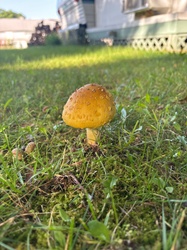
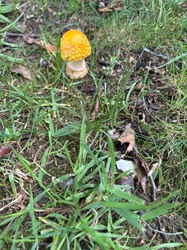
Mature caps are commonly 8 to 20 cm across and can exceed that on rich ground. The shape runs from spherical through hemispherical and convex to flat, sometimes with a slightly depressed centre in the largest specimens. Colour is scarlet to bright orange-red at its best, but this is a fading species: rain leaches pigment, sun bleaches it, and old caps can be orange, apricot or even pale yellowish while retaining a redder disc. Regional forms differ, with yellow to orange-capped populations widespread in parts of North America and red caps with yellow-tinged veil remnants elsewhere. Scattered across the surface are the remains of the universal veil: numerous white to cream warts, pyramidal or floccose, arranged more or less concentrically. They are only loosely attached, so heavy rain can wash a cap completely clean; a bare red cap is not evidence against the species. The margin becomes faintly grooved for a few millimetres in fully expanded caps.
The Gills
Underneath, the gills are free, stopping short of the stem apex and leaving a clean channel. Confirm this on a vertical cut rather than by eye. They are crowded, broad, and pure white to faintly cream, and they do not darken with age or take on a pink phase. Under a lens the gill edges look minutely flocculose. Numerous shorter gills are interleaved between the full-length ones, ending bluntly at various distances from the stem.
Stipe, Ring and the Girdled Bulb
The stem is 8 to 20 cm tall and 1 to 3 cm thick, white or cream, tapering slightly upward, and often finely scaly or shaggy below the ring. High on the stem sits a large, soft, pendulous white ring, sometimes faintly striate above and occasionally with a yellowish edge, which may collapse against the stem in wet weather. The base is where the identification is completed, so excavate rather than pull. It swells into an ovoid to almost turnip-shaped bulb, and the surface of that bulb carries several concentric rings, ridges or shaggy girdles of veil tissue, like a series of scaly collars stacked above one another. Critically, there is no free membranous sack that can be opened out with a fingernail; the veil remains fused to the bulb as those girdles.
Flesh and Colour Change
Slice the fruit body from cap to base. The flesh is white and firm, and there is one small but genuinely useful detail: directly beneath the cap skin lies a thin layer flushed pale orange to yellow, echoing the cap colour. Peel a strip of cap skin and it lifts easily, exposing that tinted layer. Elsewhere the flesh is white and unchanging; it does not redden, blacken or blue. The stem is stuffed with soft cottony tissue that becomes hollow in old specimens. The smell is faint and mushroomy.
Taking a Spore Print
Cut the stem flush with the gills and set the cap gill-side down on black paper, or on a sheet that is half black and half white, covered with a bowl for four to twelve hours. The deposit is white. On a dark background it appears as a soft chalky bloom in the pattern of the gills. In this genus the print is a confirmation rather than a discriminator, since all the close relatives also print white; its real value is in excluding the pink-spored and brown-spored genera that occasionally mimic the general shape.
Substrate, Season and Ecology
Amanita muscaria is an ectomycorrhizal fungus, forming sheathing partnerships with the fine roots of its host trees and exchanging soil-derived nutrients and water for carbon. Birch is the classic partner across the northern range, with pine, spruce and fir also strongly associated, and oak, beech and other hosts used locally. It has travelled widely with planted birch and conifers, establishing far outside its native range and, in some places, transferring onto native trees. Fruiting runs from late summer well into autumn and continues until hard frosts, often in arcs and troops beneath a single host tree. Because the mycelium is a long-lived root partner, productive spots repeat year after year, and the fungus is always in soil, never on wood.
Separating It from Look-Alikes
Within the genus the base tells the story. Amanita caesarea has a smooth orange cap with no warts, a strongly grooved margin, yellow gills, a yellow stem and ring, and a thick, free, white membranous sack at the base. Amanita jacksonii and its relatives are similar in that pattern, with a slim orange cap, striate margin and a white bag-like volva. Amanita parcivolvata has a red cap with scattered yellow flecks but no ring at all, and its veil remains as loose powdery material at the base rather than as firm girdles. Amanita rubescens shares the warted cap and girdled base but is pinkish brown to dull tan with greyish warts, and its flesh and insect damage flush reddish; the reddening is decisive. Amanita regalis is liver-brown with ochre warts, and the various pale yellow to orange members of the gemmata group have thin fugitive rings and a small collared bulb.
Outside the genus, red-capped Russula species can look superficially similar from above, but they have brittle flesh that snaps like chalk, attached gills, no ring, no bulb and no warts. Any red cap with a ring on the stem and a girdled bulb below deserves a careful Amanita workup.
A Field Sequence That Works
Confirm soil under birch or conifers; note a scarlet to orange cap with loosely attached white warts and a faintly grooved margin; verify free, white, non-darkening gills; find a large pendulous ring high on a white stem; excavate the base and confirm a swollen bulb with concentric shaggy girdles and no free sack; peel the cap skin and look for the orange-tinted layer beneath; finish with a white spore print.
Common questions
What does the stem base look like, and why does it matter?
Can it still be identified if the white warts have washed off?
Which trees is it associated with?
Why does it appear in places far outside its native range?
Full reference entry for Fly Agaric | Amanita muscaria
Cap and fruiting body, spore print colour, substrate, season, ecological role and the species most often confused with it.
Open the Fly Agaric | Amanita muscaria entry →