
Fungi encyclopedia
A reference for the fungi you actually find
Each entry describes one species the way you meet it in the field — the cap and its surface, what sits underneath, the stipe and its base, the spore print colour, the substrate it fruits from, and the species most often confused with it.
Showing results for “White Jelly Fungus”
Woolly Tooth
Toothed
A thin, leathery toothed fungus forming zoned cinnamon funnels that fuse into rosettes across mossy conifer floors. Its white spore print separates it from the similar brown-spored Hydnellum species.
Spore print · White
Common Jellyspot
Jellies
Minute orange-yellow jelly blobs scattered in numbers over damp dead wood and old fence posts, among the most frequently encountered of all small fungi.
Spore print · Whitish to pale yellow
Beech Jellydisc
Jellies
Translucent, gelatinous pinkish-buff discs crowded together on fallen beech wood, often forming knobbly cushions. The soft rubbery texture and pale lilac tint distinguish it from darker jelly fungi.
Spore print · White
Red-belted Conk
Polypores
A tough perennial bracket recognised by a shiny resinous crust banded in red-orange with a cream to white growing edge, and a hard white context. It is among the most abundant decay fungi of conifer logs in northern forests.
Spore print · White
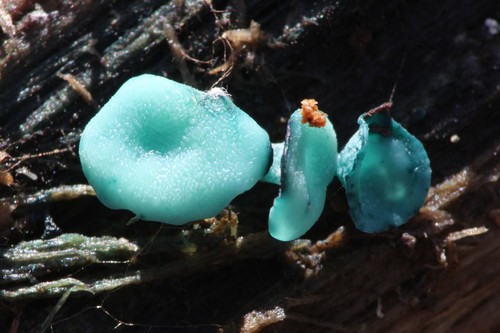
Green Elfcup
Cups & Discs
A tiny turquoise cup fungus whose mycelium stains rotting hardwood a vivid blue-green. The stain is visible all year, while the small stalked saucers appear mainly in damp autumn weather.
Spore print · White
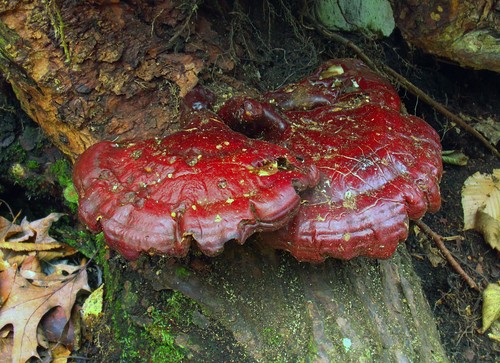
Hemlock Varnish Shelf
Polypores
A shiny, varnish-coated bracket with a mahogany-red upper surface and creamy white pore layer, fruiting almost exclusively on dead eastern hemlock. Its lacquered finish and conifer substrate make it one of the most recognisable shelf fungi of northern forests.
Spore print · Brown