Community find
Oyster Mushroom
Pleurotus ostreatus
- Group
- gilled mushroom
- Season
- Oyster mushrooms can be found throughout the year in many temperate regions, especially after periods of rain. They are particularly common in late spring, summer, and fall, but can also fruit in mild winter conditions.
- Habitat
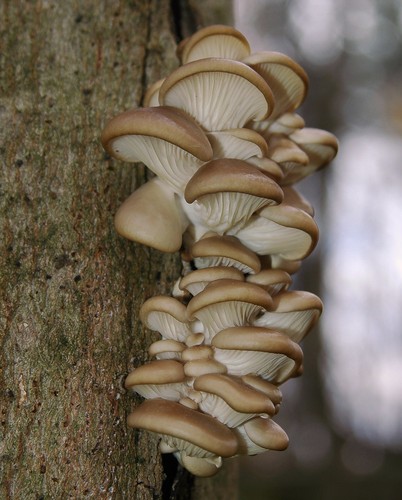
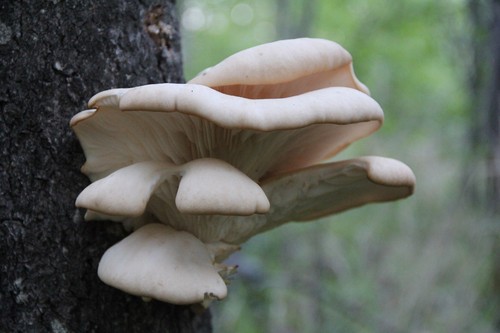
- Oyster mushrooms grow in shelves or overlapping clusters on dead or dying hardwood trees, such as oak, maple, beech, and poplar. They can also be found on conifer wood in some regions. They prefer humid environments and are often found in forests, woodlands, and sometimes even in urban park settings where suitable host trees are present.
- Key characteristics
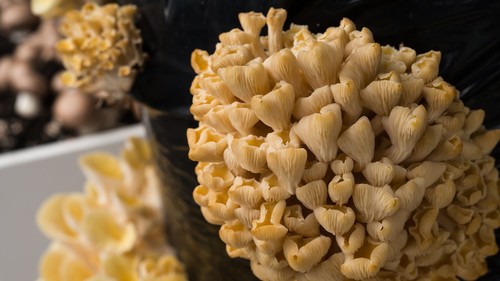
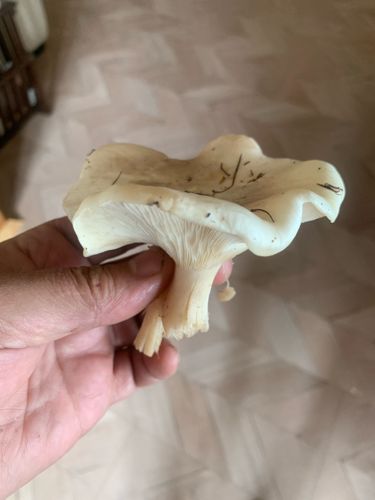
- The mushroom typically has a fan-shaped or oyster-shell-shaped cap, often with wavy or lobed margins. The cap color can range from white, cream, or buff to various shades of gray or light brown. The gills are broad, closely spaced, and decurrent (running down the stem). The stem, if present, is usually short, thick, and off-center or almost absent, blending into the cap. The texture is generally smooth and slightly moist. Spore print is white to lilac-gray.
- Look-alikes
- There are several species within the Pleurotus genus that look similar, such as the Elm Oyster (Hypsizygus ulmarius) which has a more central stem and grows singly or in small clusters, unlike the shelf-like growth of Pleurotus ostreatus. Another similar-looking mushroom is Crepidotus, which tends to be much smaller, lacks a well-defined stem, and has a brown spore print rather than white or lilac-gray. Careful examination of growth habit, spore print, and specific cap/gill characteristics is important for differentiation.
- Ecological role
- Oyster mushrooms are primarily saprophytic, meaning they obtain nutrients by decomposing dead organic matter, particularly wood. They play a crucial role in forest ecosystems as primary decomposers, breaking down fallen logs and branches, thereby recycling nutrients back into the soil. They are also known to be nematophagous, meaning they can trap and digest nematodes (microscopic worms) to supplement their nitrogen intake. This decomposition activity is vital for maintaining healthy forest environments.