Community find
Saffron Milkcap
Lactarius deliciosus
- Group
- gilled mushroom
- Season
- Late summer to late autumn, depending on geographical location and local climate conditions. Fruiting is often triggered by rainfall.
- Habitat
- Typically found on the ground in coniferous forests, particularly under pine, spruce, or fir trees. It prefers acidic soils and can be found solitarily or in scattered groups.
- Key characteristics
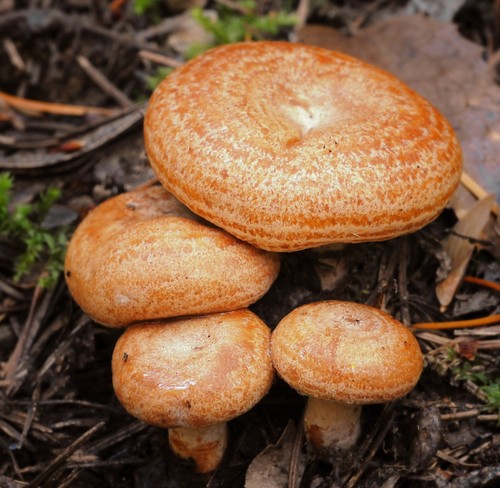
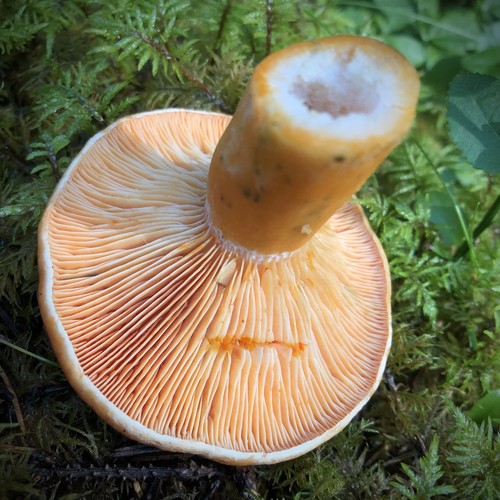
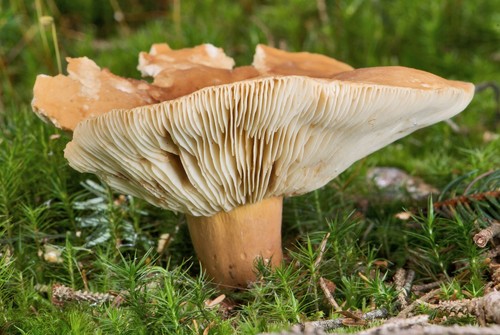
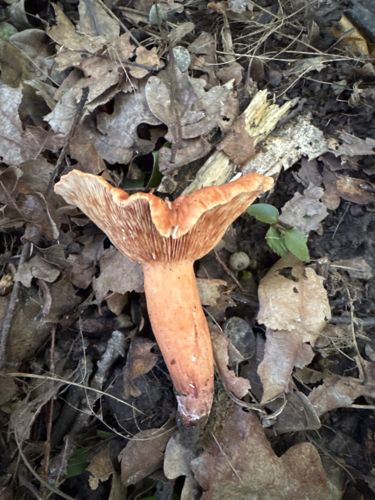
- The cap is funnel-shaped to broadly convex with a depressed center, featuring concentric zones of color. Its color can range from orange to reddish-brown, often fading with age. The surface is smooth and slightly sticky when moist. Gills are decurrent, closely spaced, and the same color as the cap, or slightly paler. The stem is cylindrical, often hollow, and also orange to reddish-orange, sometimes with darker spots or pits.
- Look-alikes
- Lactarius sanguifluus (Bleeding Milkcap) which exudes a dark red latex, and other Lactarius species that produce orange latex but may not have the true carrot-orange color of L. deliciosus. Care must be taken to distinguish it from other orange-capped Lactarius species that may not be as desirable.
- Ecological role
- Mycorrhizal, forming a symbiotic relationship with the roots of certain trees. This relationship benefits both the fungus and the tree, as the fungus helps the tree absorb nutrients and water, while the tree provides sugars to the fungus. They are important in nutrient cycling within their ecosystems.