Identification guide
Deer Mushroom Identification Guide
A step-by-step field guide to Pluteus cervinus, the fawn-capped wood mushroom with free gills that ripen salmon-pink. Covers the streaked cap and stipe, the pink spore print, hook-tipped cystidia and how to separate it from Entoloma, Volvariella and its Pluteus relatives.
The Log and the First Look
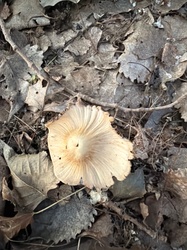
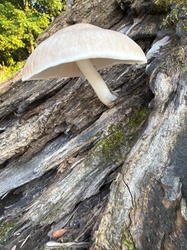
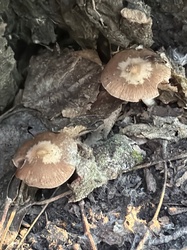
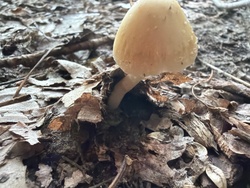
The Deer Mushroom is one of the fungi you meet by paying attention to dead wood rather than to the forest floor. The usual scene is a hardwood log slumping into the ground, an old sawn stump, a pile of ageing woodchip along a trail, or a bare patch of ground over a buried root. Out of it come one, two or a handful of soft, grey-brown, evenly domed caps on white stems, generally not clustered tightly but standing apart from one another.
The first impression is of something plain and slightly floppy, a medium-sized mushroom in the colour of a deer's flank, with a stem that looks white from a distance but is streaked dark on closer inspection. It has no ring, no volva, and no obvious ornament. That plainness is the point: this species is identified by what it does not have as much as by what it does, and the whole identification hangs on the pairing of free gills with a pink spore print.
Step One: Look Underneath Before Anything Else
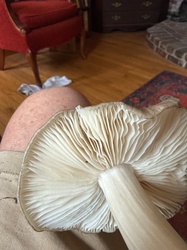
Get the cap upside down in your hand while it is still fresh. The gills should be crowded, fairly broad, soft, and completely free, stopping short of the stem so that a clear channel runs all the way round it. Push the gills gently with a fingertip; they should peel from the cap flesh easily and never run down onto the stem.
Then read their colour, which changes as the fruitbody ages. Very young gills are white. As spores ripen they pass through pale pinkish to a distinct salmon or flesh-pink, and mature caps look decidedly pink underneath. On some collections the gill edge is finely brownish under a lens. White-then-pink free gills on a mushroom growing from wood is the core signature.
Step Two: The Cap
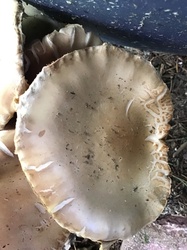
Caps run 4 to 12 cm across, sometimes larger on rich substrates such as sawdust. Young caps are conical to bell-shaped, then convex, finally almost flat with a low broad umbo. The margin is even, thin, and may split radially in dry weather.
Colour spans a wide range of browns: fawn, deer-brown, mouse-grey, dark sooty brown, sometimes almost blackish at the centre and always paler towards the rim. The surface is smooth to the touch and finely streaked with darker innate radial fibrils that give a silky, brushed look; it is very slightly greasy when wet and matt when dry. The centre of an expanded cap is often minutely wrinkled. Importantly, there are never loose scales or patches of veil tissue on the cap surface.
Step Three: The Stipe and Base
The stipe is 5 to 12 cm tall and 5 to 15 mm thick, more or less equal or slightly widened downwards, solid and fibrous. It is white to greyish, and covered along its length with fine longitudinal brownish or blackish fibrils, denser towards the base, so the stem looks streaked or brushed rather than clean.
Now check what is absent. There is no ring and no ring zone. There is no volva or membranous bag at the base. The base may be slightly swollen and is usually bound to the wood with white mycelial threads, sometimes carrying wood fragments. Those two absences, combined with free gills, eliminate a great deal.
Step Four: Flesh and Odour
Split the fruitbody lengthwise. The flesh is white and soft in the cap, more fibrous in the stem, and does not change colour when cut or bruised, at most greying slowly as it dries. There is no latex, no rapid blueing, no reddening. The smell of crushed fresh flesh is mild, often described as faintly raphanoid, a soft radish note.
Step Five: The Spore Print
The print settles it. Cut the stipe flush, lay the cap gills-down on white paper, cover it with a bowl and leave it three to six hours; overnight is fine for young caps. The deposit is pink, running from pale salmon to a slightly brownish rose. Compare it with the white paper margin to be sure the tint is real.
Under the microscope the spores are smooth, broadly ellipsoid to ovoid, about 6 to 8 by 4 to 5.5 micrometres, and inamyloid. The decisive microscopic character sits on the gill face: large, thick-walled pleurocystidia crowned with two to four short, curved apical horns or hooks. Those hooked metuloids are the hallmark of the group Pluteus cervinus belongs to and settle awkward collections at once.
Substrate and Season
Pluteus cervinus is a wood-decay saprotroph, causing a white rot in dead hardwood. It fruits on fallen trunks, sawn stumps, root plates, sawdust piles, landscape woodchip and buried woody debris, with beech, birch, poplar, willow, elm, maple and oak all common hosts, and occasional appearances on conifer waste. Because it exploits mulch so readily, it is as much an urban park species as a woodland one.
The season is long. This is one of the earlier fleshy fungi of the year, often appearing in spring, then continuing in flushes through summer and autumn wherever the substrate stays damp, and in mild regions into early winter. Fruitbodies are typically solitary or in small scattered groups rather than in tight tufts.
Separating the Look-alikes on Morphology Alone
Entoloma species also drop a pink print, but their gills are attached to the stem, they grow from soil rather than wood, and their spores are angular with distinct facets rather than smooth and rounded.
Volvopluteus and Volvariella share free gills and a pink print but sit in a distinct membranous volva at the stem base; dig one out and the difference is immediate.
Pluteus atromarginatus grows on conifer wood and has gills with a sharply dark brown to blackish edge, visible with a hand lens.
Pluteus pouzarianus is another conifer-wood species, essentially separable by the presence of clamp connections in its tissues.
Pluteus salicinus is smaller, with a greyish cap carrying greenish or bluish tints, especially near the stem base.
Pluteus petasatus is generally paler, whitish to cream with small darker scales concentrated at the disc, and is common in bulk woodchip and sawdust.
Pluteus umbrosus has a strongly net-veined dark brown cap and dark gill edges.
Tricholoma and Melanoleuca species may look similar from above but have gills attached to the stem and a white spore print.
Field Checklist
Growing from hardwood, chips or buried wood; a smooth, radially streaked deer-brown cap; free crowded gills passing from white to salmon-pink; a white stem streaked with dark fibrils; no ring and no volva; unchanging white flesh with a faint radish smell; a pink spore print; and hook-tipped pleurocystidia under the microscope.
Common questions
What two features identify a Deer Mushroom fastest?
How do I distinguish it from a pink-spored Entoloma?
Which substrates does it favour?
When is it likely to be fruiting?
Full reference entry for Deer Mushroom
Cap and fruiting body, spore print colour, substrate, season, ecological role and the species most often confused with it.
Open the Deer Mushroom entry →